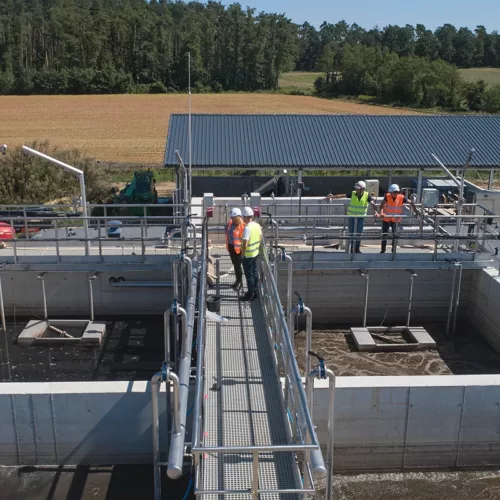
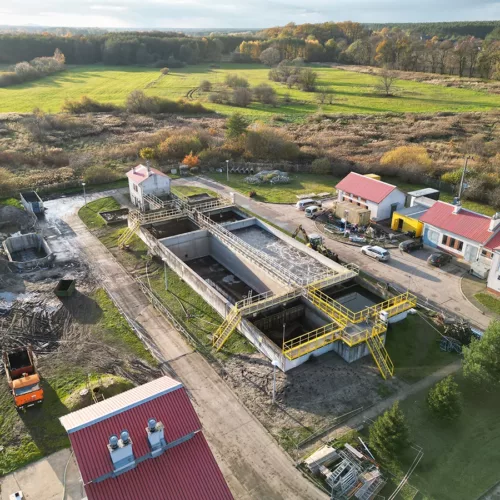
Municipal wastewater treatment plant in Sucha Wielka (Zawonia municipality, Lower Silesia Province) was thoroughly modernised between 2022 and 2024 by a consortium of companies: NEWATER sp. z o.o. and MAS-BUD Firma Ogólnobudowlana. Before the upgrade, it was a Lemna-type treatment plant; today it is a modern and efficient facility based on the operation of a B-PFR reactor.
Wastewater treatment in Lemna ponds involves the use of an aquatic plant, duckweed (Lemna minor), to remove pollutants from wastewater.
How Lemna ponds work
This process is natural and environmentally friendly, as duckweed absorbs biogenic compounds such as nitrogen and phosphorus, which are present in sewage. Lemna ponds act as retention and equalisation reservoirs, where duckweed covers the entire water surface, preventing the multiplication of phytoplankton below water surface. This type of wastewater treatment plant is suitable for use in smaller centres and anywhere where uneven wastewater flow occurs, e.g. in schools, agritourism facilities, holiday homes and hostels. However, they have the disadvantage of being dependent on climatic conditions – the efficiency of wastewater treatment plants decreases significantly as temperatures drop, which is inevitable in our climate zone. Furthermore, Lemna ponds require regular removal of excess duckweed.
How the work progressed
The reconstruction and expansion of this wastewater treatment plant was not an easy process. It was very challenging, both technically and organisationally, to install a partition on one of the ponds – part of it had to remain in place to continue cleaning the sewage that was still flowing in. The rest of the pond had to be removed to make space for new structures. Therefore, the partition was erected on a wet tank filled with sewage. There was a thick layer of sediment at the bottom. Several hundred tonnes of sediment from both ponds had to be drained and disposed of. The construction was carried out by MAS BUD Firma Ogólnobudowlana (a consortium member of NEWATER), and the technological commissioning was performed by J.V. Technology Witold Woroszyłło.
B-PFR reactor
Wastewater is currently treated using innovative activated sludge reactors of modular design. This is a biological treatment method, in a continuous flow system, with separate phases within a single tank. This type of reactor is characterised by continuous inflow of raw sewage, while the operating cycle is divided into sequences. Consequently, the environmental performance of the new facility is more than satisfactory – all treated wastewater quality parameters (BOD5, COD, total suspended solids) are several times lower than those specified in environmental standards.
Advantages of the applied solutions
B-PFR activated sludge reactors offer a number of advantages over traditional solutions, and also make subsequent operation much easier.
Key advantages of B-PFR systems include:
How it works
The B-PFR biological reactor operates in a sequential manner – in successive, consecutive phases. It can be filled throughout the entire cycle. Simultaneously, the reactor design prevents raw sewage from being mixed with treated sewage. The reactor allows for all technological processes to be carried out without the need to separate individual chambers (dephosphatisation, denitrification, aeration).
The design and timing of the reactor cycle sequence creates ideal conditions for the sludge granulation process, resulting in a very low sludge index in the reactor, which in turn affects the hydraulic performance of the system.
The reactor’s technological solution comprises a complete set of devices and measurements that are closely linked to the control system. The technological set-up, along with the control system, enables the process and its individual phases to be carried out in connection with the time and measurement function – enabling the intensity and length of the cycle and the operation of individual pieces of equipment to be continuously adjusted depending on the current composition of the raw sewage (treatment plant load) and the requirements for the quality of the treated sewage.
The use of the technological set-up and control system enables optimal purification process management with full control over the operation of individual devices and adjustment of the cycle length and its individual phases, which consequently leads to a significant reduction in electricity consumption at the wastewater treatment plant.

Added: 16.05.2025 r.

Leave your phone number and we will contact you!
Thank you, we will contact you soon!