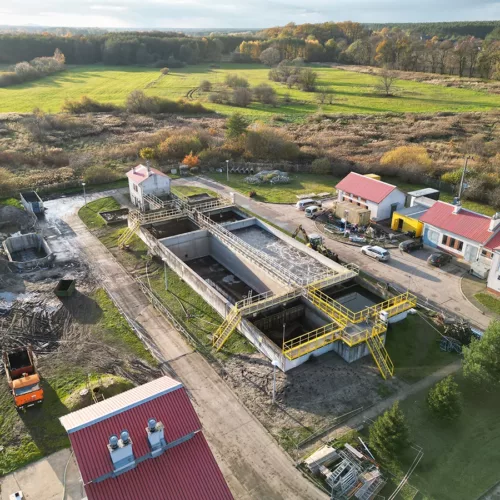
The municipal wastewater treatment plant in Sucha Wielka (Zawonia municipality, Lower Silesian Voivodeship) has been extensively modernised in recent years. The key element of the reconstruction, carried out by NEWATER, is the proprietary B-PFR biological reactor.
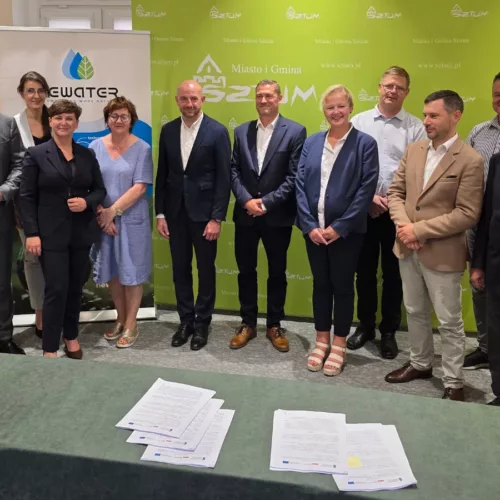
The performance of the new reactor and the operation of the entire treatment plant will be the subject of scientific research conducted by the Wrocław University of Environmental and Life Sciences. An agreement on this matter was concluded between the Municipality of Zawonia and NEWATER.
Currently, as much as 90% of the total wastewater load entering treatment plants is the so-called hauled wastewater – originating from septic tanks and domestic treatment plants. This is an unusual situation: facilities of this size usually generate no more than a few per cent of such wastewater. Such high proportions are connected with significant technological challenges – primarily due to large fluctuations in pollutant loads and the increased content of solid particles such as sand and gravel.

Despite these difficulties, the treatment plant in Sucha Wielka achieves very good treated wastewater parameters. This is possible thanks to the proprietary technological solution – the B-PFR reactor.
This reactor is based on low-oxygen-load stabilised activated sludge technology with biological removal of biogenic compounds in a continuous flow system. The structure of the facility allows for physical separation of individual process phases in a single tank, which prevents mixing of raw and treated sewage and enables maintenance of stable operating conditions.
– The structure and cycle sequence have the potential to create ideal conditions for sludge granulation, resulting in very low sludge index and, consequently, increased hydraulic efficiency of the system, explains Dominik Żółtowski, chief technologist and author of the project.


According to the agreement signed on 1 July 2025, the municipality of Zawonia will make the treatment plant available for research into the structure of activated sludge that is produced in the reactor. Samples will be collected several times, and the analyses will be carried out by the Institute of Environmental Engineering at the University of Life Sciences in Wrocław, which has a modern research laboratory at its disposal.
The aim of the research is to analyse the structure of the sediment, the dynamics of its concentration during reactor operation, and to determine the limiting concentrations at which the sedimentation process can be carried out under specified hydraulic conditions.
Robert Malik, CEO of NEWATER, emphasises that cooperation with the university is an opportunity for further technological development:
–We do not intend to rest on our laurels after developing the B-PFR reactor. We want to maximise its potential and continue with development. Energetic efficiency and improved surface water quality are our targets.

Added: 12.08.2025 r.

Leave your phone number and we will contact you!
Thank you, we will contact you soon!